








Dear Friends and Neighbors,
It’s been another busy few weeks, and one of the best parts of serving the 8th District is getting out into our communities, connecting with local leaders and seeing firsthand the work happening across our region and state.
From energy innovation and workforce development to honoring those who have served our country, I’ve had the opportunity to participate in several meaningful events over the past couple of months. Here are a few highlights:
-
Sept. 1 | Fusion Week at WSU Everett: The “Fusion Energy Policy Landscape” panel, hosted by Mike Dixon, brought together leaders to discuss state energy policy, the future of fusion and nuclear energy, and the role higher education plays in preparing our workforce for emerging industries.
-
Sept. 10 | Tri-Tech Skills Center ribbon-cutting: Community and education leaders gathered in Kennewick to celebrate the modernization of Tri-Tech Skills Center, supported by more than $45 million in state investment. It was exciting to see investments that help students develop the skills they need for good-paying careers.
-
Sept. 11 | 9/11 remembrance ceremony: I was honored to deliver the keynote address at Kennewick’s 9/11 remembrance ceremony. The event provided a meaningful opportunity to remember the lives lost, recognize the courage of our first responders and reflect on the importance of service and sacrifice.
-
Oct. 6 | Legislative energy committee meeting: The Joint Committee on Energy Supply, Energy Conservation and Energy Resilience met to continue examining Washington’s energy needs and reliability. I participated in discussions about the challenges facing our state’s energy future.
- Oct. 8 | Washington State Academy of Sciences: I joined Sen. Ron Muzzall and Rep. Cindy Ryu for a legislative-issues panel during the academy’s annual induction ceremony. Our discussion highlighted public policy and the important relationship between scientific research and decisions made in Olympia.
These events are tied together by the importance of preparing for Washington’s future. Whether we’re talking about reliable energy, career opportunities for young people, or the research driving new technologies, today’s decisions will shape our communities for years to come.
These conversations also reinforce why staying connected matters. As we prepare for the 2027 legislative session, I want to ensure the priorities and concerns of the people I represent remain at the center of our work in Olympia.
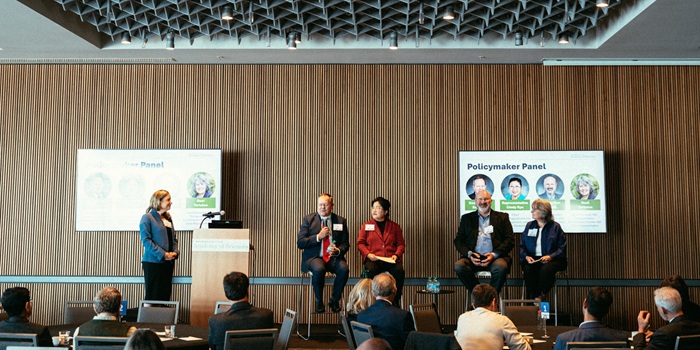
Sen. Matt Boehnke, R-Kennewick, participates in the “Fusion Energy Policy Landscape” panel during Fusion Week at Washington State University Everett on Sept. 1, 2026. The discussion focused on state energy policy, the future of fusion and nuclear energy, and higher education’s role in preparing Washington’s workforce for emerging industries.
Looking ahead to 2027: Washington's budget challenges
While there’s plenty of exciting work happening across our region, there are also some difficult decisions ahead when the Legislature returns to Olympia in January. One of the biggest will be how we manage Washington’s growing state budget and make sure taxpayers are getting the results they deserve.
In my last email update, I shared my concerns about rising state spending and the tax and fee increases approved in recent years. Since then, we’ve received an updated revenue forecast that gives us a clearer picture of the state’s financial outlook. We’ve also heard some interesting perspectives from two former Democratic governors, Gary Locke and Christine Gregoire, who have raised concerns about fiscal discipline and Washington’s business climate. I’ll get to their comments in a moment, but first, let’s look at the numbers.
According to the Washington State Economic and Revenue Forecast Council, Washington is projected to collect approximately $76.3 billion during the current 2025-27 budget cycle. That figure is expected to increase to $82.6 billion in 2027-29 and $94.1 billion in 2029-31.
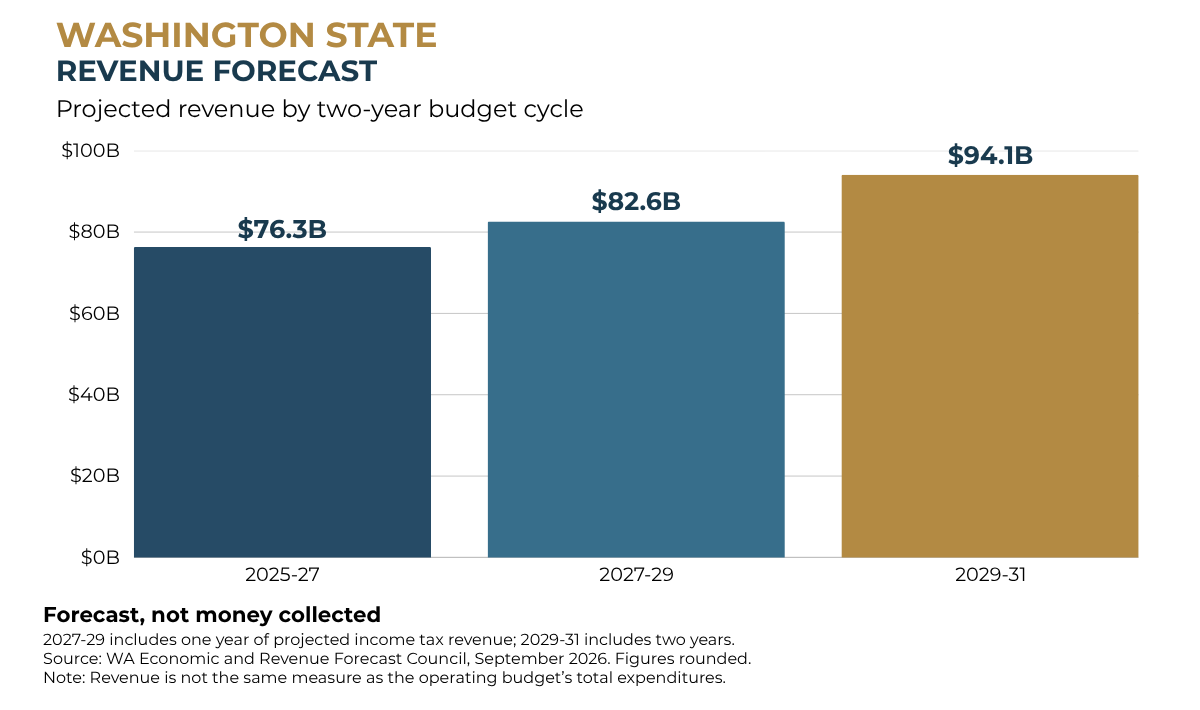
Note: These are revenue projections, not actual collections or total operating budget expenditures. The future forecasts include anticipated revenue from the new income tax. Washington’s September 2026 revenue forecast projects continued growth in state collections. Figures represent forecasts, not actual revenue or operating budget expenditures, and include anticipated revenue from the new income tax.
Those are some pretty big numbers. So why are we still facing budget shortfalls? Despite projections showing billions more in revenue, Washington is facing an estimated $5 billion to $10 billion budget shortfall for the 2027-29 biennium. That’s a significant gap, especially considering how much state spending has already increased.
Ten years ago, Washington’s two-year operating budget was approximately $38.2 billion. Today, it’s about $80.2 billion. State spending has more than doubled in a decade, yet we’re still struggling to pay for the commitments we’ve made.
And the requests for additional funding keep coming. At a recent Technology Services Board meeting, we heard that the state’s OneWashington technology modernization project is seeking approximately $148 million in additional funding. This major effort aims to replace outdated state financial and administrative systems, and modernization is certainly needed. But when a project requires substantial additional taxpayer dollars, we need clear answers about its costs, progress and expected results.
That’s where transparency, independent auditing and accountability become especially important. We need to know where taxpayer dollars go, whether programs and projects meet their goals, and why costs are increasing. Audits shouldn’t simply identify problems after the money has been spent. Their findings should help lawmakers make better decisions, correct problems and prevent the same mistakes from happening again.
I’ve said before that I don’t believe Washington’s budget challenges can be solved simply by collecting more money from taxpayers. We have important responsibilities to our schools, public safety, transportation system and vulnerable residents. But fulfilling those responsibilities also means managing the resources we already have wisely. Before approving new spending or asking families and businesses to pay more, we should be asking some basic questions: What’s working? What isn’t? Are taxpayers getting the results they were promised? And can we afford these commitments five or 10 years from now?
As we prepare for the 2027 legislative session, I believe greater fiscal discipline, meaningful oversight and accountability for every taxpayer dollar need to be at the center of our budget discussions. And as you’ll see in the next section, these concerns aren’t limited to one political party.
Some unexpected voices in the budget conversation
I’m not the only one raising concerns about Washington’s spending and economic future. Two former Democratic governors, Gary Locke and Christine Gregoire, have recently shared some perspectives worth considering.
Locke, who served as governor from 1997 to 2005, recently criticized the Legislature’s approach to spending, particularly the practice of using temporary funding to pay for ongoing programs. His concern is one I’ve raised before: Just because money is available today doesn’t mean we can count on it being there tomorrow. When government makes long-term commitments without a sustainable way to pay for them, taxpayers can end up footing the bill.
What caught my attention was hearing a former Democratic governor raise concerns similar to those I’ve heard from families and businesses across the 8th District. We may not agree on every solution, but responsible budgeting shouldn’t be a partisan issue.
Former Gov. Christine Gregoire talks business, jobs and Washington's future
Former Gov. Christine Gregoire also offered some interesting perspectives during a recent episode of Elephant in the Dome, the Senate Republican Caucus podcast. In her conversation with Sen. Chris Gildon, Gregoire discussed Washington’s changing business climate, the importance of remaining competitive and the need for greater fiscal responsibility.
She also made an important point about the role businesses play in our communities beyond generating tax revenue. They’re where jobs are created, investments are made and opportunities begin. We see that firsthand in the Tri-Cities. From the businesses supporting the Hanford cleanup mission and researchers at Pacific Northwest National Laboratory to our energy producers, manufacturers, farmers and small businesses, these employers are the backbone of our regional economy.
But as taxes, regulations, and operating costs continue to rise, businesses face tougher decisions about hiring, expanding, and investing. Those decisions affect more than the bottom line. They affect local jobs, family budgets and the opportunities available in our communities.
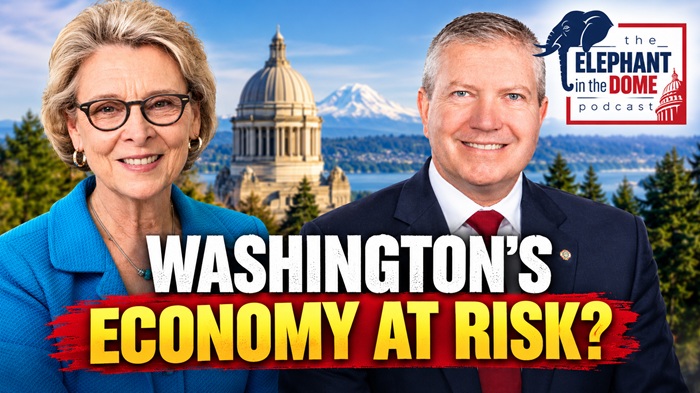
Gregoire also raised concerns about Washington’s declining competitiveness, something especially relevant as Eastern Washington looks to expand its role in energy, advanced manufacturing and emerging technologies.
I appreciate hearing these perspectives from leaders who have faced the challenges of managing state government. We don’t have to agree on every issue to recognize the importance of responsible spending and a strong economy. As we prepare for the 2027 legislative session, I hope we’ll see more conversations across party lines, focused on what’s best for the people and communities we represent.
If you have about 20 minutes, I encourage you to watch Gregoire’s conversation on Elephant in the Dome. It’s an interesting discussion about Washington’s economic challenges, the future of our business climate and the decisions facing our state.
What's driving up the cost of fuel in Washington?
One concern I’ve been hearing from people across the 8th District is the rising cost of gasoline and diesel. Whether it’s families filling up their cars, farmers fueling their equipment or businesses keeping trucks on the road, higher fuel prices affect just about everyone.
And the impact doesn’t stop at the gas pump. Higher fuel costs can mean more expensive groceries, increased transportation costs and additional pressure on local businesses already dealing with rising expenses.
The war in Iran and disruptions to global energy markets have contributed to the recent spike in fuel prices. But that’s only part of the story. Washington’s taxes and climate policies were adding to fuel costs long before these international developments.
So how much are we actually paying? According to September 2026 estimates from the Western States Petroleum Association, state and federal taxes, fees and estimated climate-program costs total approximately $1.30 per gallon of gasoline and $1.48 per gallon of diesel in Washington.
The chart below breaks down those costs, including the state’s fuel excise tax, the Climate Commitment Act’s cap-and-invest program and the Clean Fuels Standard.
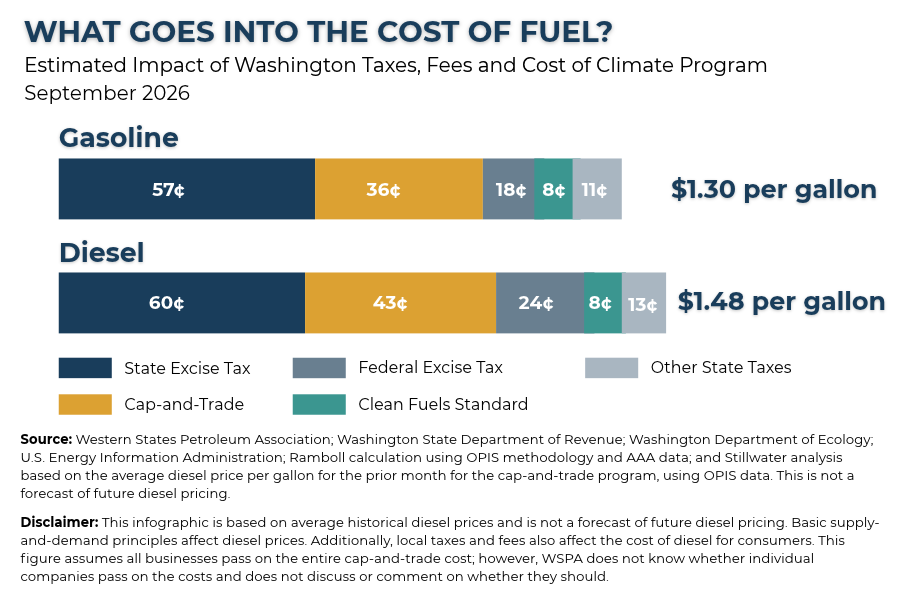
These figures are estimates, not the total price at the pump. The climate-program estimates also assume those costs are fully passed along to consumers.
Making sure the farm fuel exemption works
For our agricultural community, the issue is especially frustrating because the Climate Commitment Act was supposed to exempt qualifying agricultural fuel from cap-and-invest costs. Yet farmers have reported paying surcharges on fuel that should have been exempt.
To help address those costs, the state created the Agricultural Support Program, which offered payments of up to $4,500 for eligible agricultural fuel purchased in 2023 and 2024. But that assistance was temporary.
In 2025, lawmakers passed House Bill 1912, strengthening the agricultural fuel exemption and expressing the Legislature’s intent to continue the reimbursement program. However, the final budget did not fund the extension of those payments.
Then, in June 2026, the Washington Supreme Court upheld the Department of Ecology’s rules for administering the exemption. The ruling confirmed that Ecology’s approach was legally permissible, but it did not require fuel suppliers to stop imposing surcharges on exempt fuel.
That leaves an important question: What happens when farmers are still charged costs they should be exempt from?
The temporary assistance program has not been renewed, leaving farmers without that state-funded reimbursement option when they encounter those charges. For me, this isn’t an abstract policy debate. I know what it takes to keep a family farm operating, and farmers can’t avoid fuel costs. Every additional cost matters, especially when producers have little control over the prices they receive for what they grow.
As we head into the 2027 legislative session, we need to examine how Washington’s fuel taxes and climate policies affect families, farmers, and businesses, and whether the agricultural exemption delivers the relief it was designed to provide. When the Legislature promises farmers an exemption, that promise needs to mean something. An exemption that doesn’t reach the farmers it was meant to protect isn’t much of an exemption.
Let's keep the conversation going
As we get closer to the 2027 legislative session, I want to continue hearing from you. Whether you’re concerned about the cost of living, have ideas about how we can improve our state or need help navigating a state agency, my office is here to help.
I’ll continue sharing regular updates through December, keeping you informed about the issues I’m working on, developments affecting our region and the priorities taking shape ahead of the legislative session in January.
Thank you for taking the time to read these updates and stay involved. I appreciate the conversations, questions and ideas you share with me, and I’m grateful for the opportunity to represent the 8th District.
It’s an honor to serve you,
 Sen. Matt Boehnke, 8th Legislative District